Object: 026.02.01
Double Headed Axe
Image:
Description:
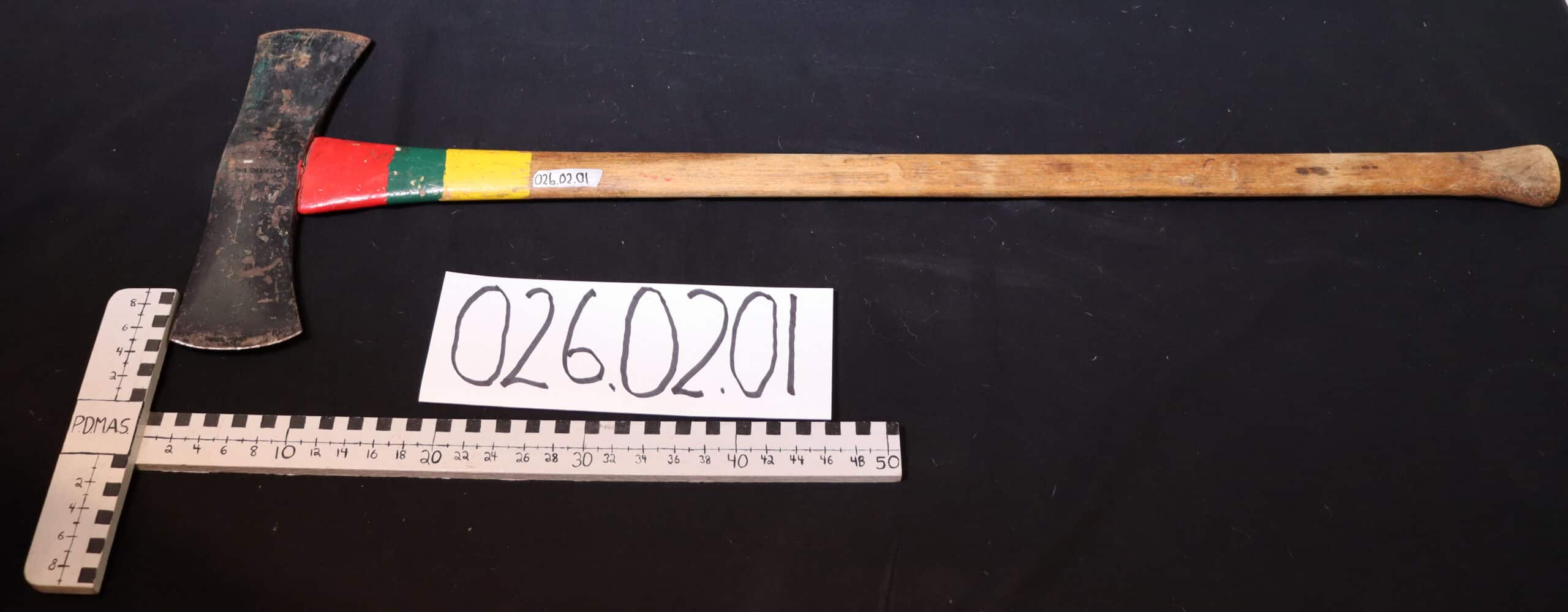
Double-Headed Axe – Forestry Branch manufactured by the Welland Vale Manufacturing Company in Ontario, almost certainly before the First World War. The axe has green, yellow, and red paint around its shoulder. One side is stamped with the marking “F ↑ B.” The arrow is a crow’s foot, a mark used by the British government to identify government property. The letters “F” and “B” stand for Forestry Branch, indicating the department in which the axe was used.
The axe head shows slight wear, but overall, it’s in good condition.
Paint Markings and Their Purpose
Historically, forestry departments, parks branches, and wildland firefighting crews painted their tools in bright, contrasting colours for several reasons:
Visibility and Loss Prevention: Bright colours such as red, yellow, and green made tools easier to locate if dropped or misplaced in dense brush or forested areas.
Agency Identification: Specific colour combinations or bands could identify the crew, region, or agency that owned the tool. Organizations such as the British Columbia Forest Service used stamps and colour markings to help track equipment.
Cutting Edge Identification: Double-headed axes have two cutting edges, which could be sharpened differently for specific tasks. Colour markings could help distinguish between them.
Different Cutting Edges
Clean Bit (Green or Yellow): Sharpened to a finer edge for felling trees and chopping clean wood where there was less risk of damaging the blade.
Grubbing or Root Bit (Red): Sharpened to a thicker, more durable edge for cutting roots, clearing brush, or working close to the ground where contact with dirt or rocks was more likely.
Although these colours were historically used for tool identification and practical purposes, the exact meaning of the paint markings on this particular axe has not been confirmed.
Source:
Found in Collection (FIC)
Date of Object:
ca. 1910s
Dimensions:
32cm L X 102cm W X 2.5cm H
Location:
New Building
Classification:
Type:
Accession #:
026.02.01
Collection:
Get a Copy of This Record
If you would like a copy of this image or PDF, please fill out our Reproduction Request form. You may also download and mail us a copy.
